

ANIMAL LOVERS (ALE+)
Interactive Learning
Hands-on and interactive classroom activities including games, maps, worksheets, role play, and student research tasks.
Interactive Learning
3 photos
Learning Content
Icebreaker Game: Guess the Species /ALE+/
https://create.kahoot.it/share/icebreaker-game-guess-the-species-ale/4cb6125d-0317-42ce-977f-e4a889baf13c
Animal Sanctuaries & Stray Animals – Research Worksheet /ALE+/
https://create.kahoot.it/share/animal-sanctuaries-stray-animals-research-worksheet-ale/98e8037b-4c9c-48d9-b414-72c5f6fba2cb
Why Do We Need Standards for Animal Protection?
https://create.kahoot.it/share/why-do-we-need-standards-for-animal-protection-ale/cf33e05b-2c64-4002-b206-1df5927f58d5
Grant Agreement No.: 2024-2-FR01-KA210-SCH-000290336
Threat Cards for Marine Wildlife Ranking Activity
1. Plastic Pollution
Description: Millions of tons of plastic waste enter the ocean every year. Animals can mistake plastic for food or get trapped in it.
Example: Sea turtles eating plastic bags, thinking they are jellyfish.
2. Overfishing
Description: Catching fish faster than they can reproduce disrupts the food chain and threatens species survival.
Example: Collapse of Atlantic cod populations in the 1990s.
3. Climate Change
Description: Rising ocean temperatures and acidification damage coral reefs and disrupt migration patterns.
Example: Coral bleaching in the Great Barrier Reef.
4. Oil Spills
Description: Oil coats animals’ bodies, poisoning them and destroying habitats.
Example: Deepwater Horizon spill in the Gulf of Mexico (2010).
5. Habitat Destruction
Description: Coastal development, dredging, and destructive fishing methods destroy breeding and feeding grounds.
Example: Mangrove deforestation in Southeast Asia.
6. Noise Pollution
Description: Ship engines, drilling, and sonar disrupt communication, navigation, and hunting for marine animals.
Example: Whale strandings linked to naval sonar.
7. Invasive Species
Description: Non-native species introduced by ships or aquaculture can outcompete native marine life.
Example: Lionfish spreading through the Caribbean.
8. Ghost Fishing Gear
Description: Abandoned fishing nets and traps keep catching and killing marine life for years.
Example: Seals entangled in lost fishing nets.
Grant Agreement No.: 2024-2-FR01-KA210-SCH-000290336
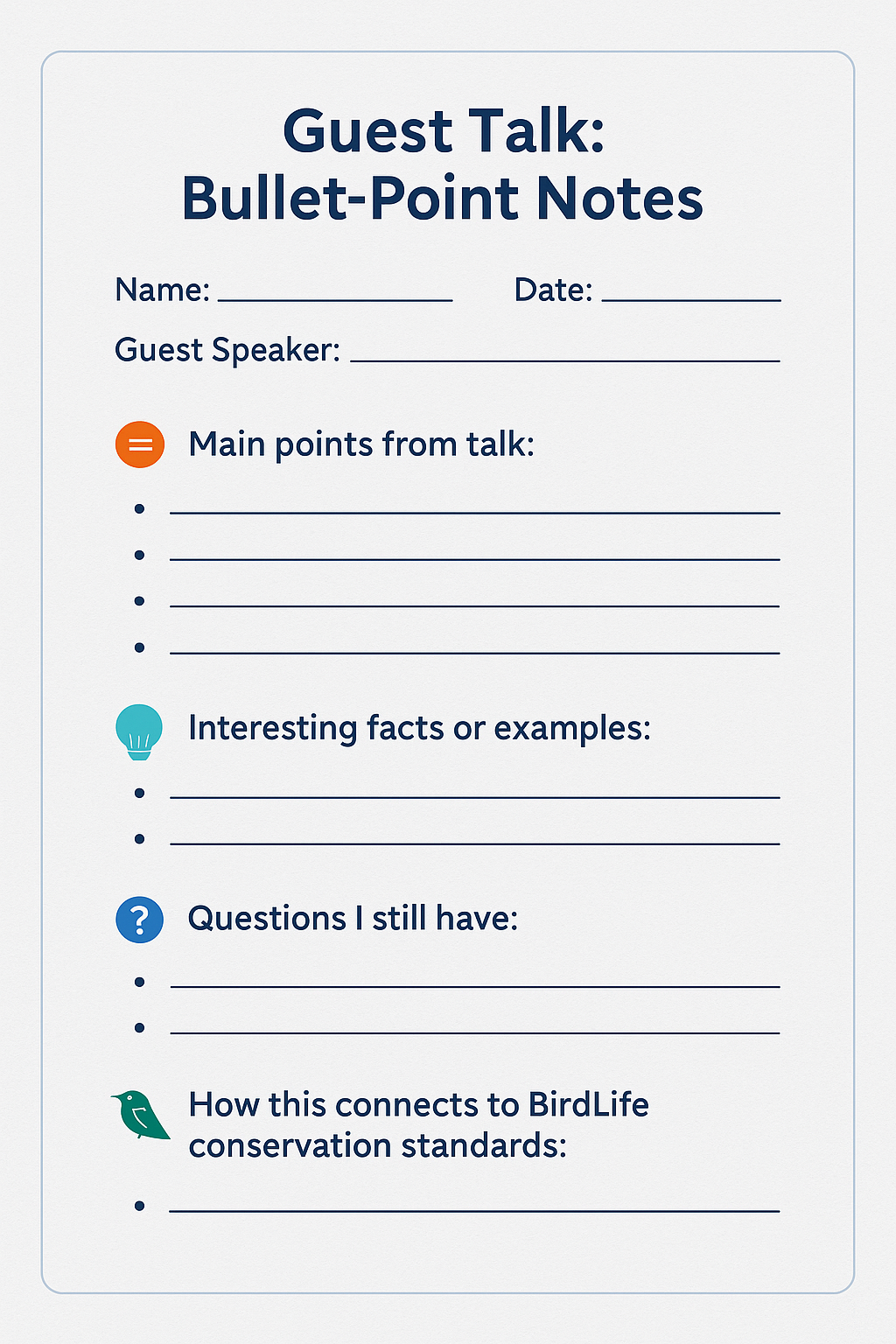
Cooperation with Local Bird Conservation Partners
Duration: 60 minutes
Learning Objectives:
Understand the role of local ornithologists and BirdLife partner organisations in bird conservation.
Develop communication and networking skills through interaction with a guest expert.
Practise inquiry skills by asking informed questions.
Take structured bullet-point notes for future reference.
Activity Outline:
1. Introduction (10 min)
Welcome guest speaker (local ornithologist or BirdLife partner representative).
Brief overview of their background and conservation work.
Explain note-taking expectations: bullet points, main ideas, no full sentences unless quoting.
2. Expert Talk (25 min)
Possible topics may include:
Local bird species at risk.
Current conservation projects and community involvement.
Monitoring techniques and citizen science initiatives.
Challenges in local bird protection.
3. Q&A Session (15 min)
Students ask prepared or spontaneous questions.
Teacher facilitates to ensure a variety of topics are covered.
4. Reflection & Wrap-up (10 min)
Students share one insight from their notes with the group.
Teacher summarises main takeaways and links them to the overall BirdLife standards theme.
Learning Outcomes:
Demonstrate understanding of local bird conservation efforts.
Record information in clear, concise bullet points.
Engage confidently with conservation professionals.
Student Material:
Bullet-Point Notes Template
Name:___________________Date:___________________Guest Speaker: ___________________
Main points from talk:
Interesting facts or examples:
Questions I still have:
How this connects to BirdLife conservation standards:
Grant Agreement No.: 2024-2-FR01-KA210-SCH-000290336
Introduction to Hypertext Mapping
Duration: 45 minutes
Led by: Teacher / ICT Trainer
Objective:
To introduce students to the concept of hypertext maps and their use in environmental studies.
To develop digital literacy and spatial thinking skills.
Description:The teacher or ICT trainer will begin by explaining what hypertext maps are—interactive digital maps that link various types of information (texts, images, videos, data) through clickable elements. The session will include examples of environmental mapping tools, such as interactive maps showing biodiversity hotspots, pollution data layers, or migratory bird routes. Students will explore how these maps help visualize complex environmental information spatially and thematically.
Learning outcomes:
Understand the basics of hypertext maps and how they function.
Recognize the role of digital mapping tools in environmental education and research.
Develop skills in interpreting and navigating interactive spatial information.
Worksheet – Introduction to Hypertext Mapping
Part 1: Before the Lesson
What do you think a hypertext map is?
Have you ever used an interactive map online? Where?
Part 2: During the Lesson3. Write down three types of information that can be linked in a hypertext map.
Name one example of an environmental hypertext map shown today.
What is one benefit of using hypertext maps in environmental studies?
Part 3: After the Lesson6. Explore the provided sample hypertext map. Write one new fact you learned from exploring it.
How could hypertext maps help you in your studies or daily life?
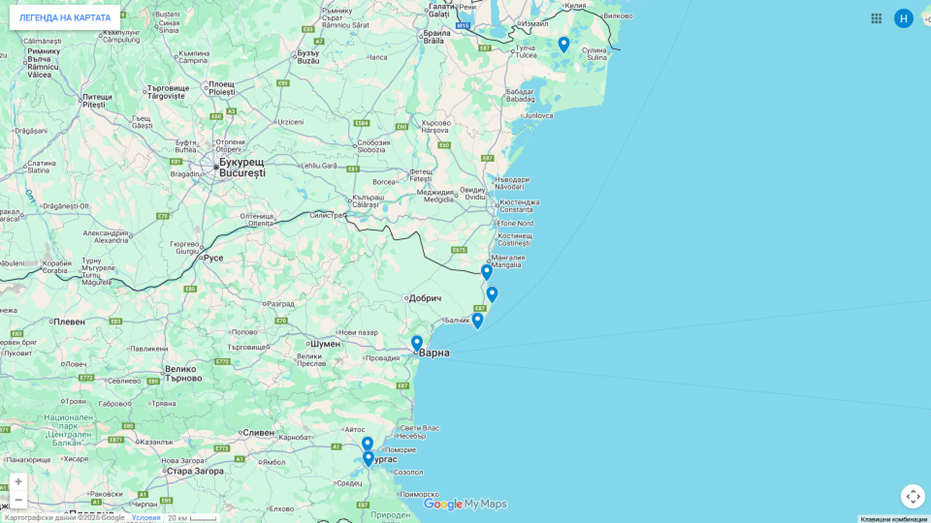
Dataset – Via Pontica Interactive Map
Title | Latitude | Longitude | Type | Short Description | Suggested Media | Links
Durankulak Lake | 43.675 | 28.553 | Wetland | Northernmost Bulgarian site; key wintering area for the Red-breasted Goose and Dalmatian Pelican. | Photo of lake, bird calls audio, student field notes. | BirdLife factsheet
Shabla Lake Complex | 43.529 | 28.605 | Wetland | Important migration stop for geese, ducks, and waders; connected to nearby marine habitats. | Bird photos, migration data charts. | BirdLife factsheet
Cape Kaliakra | 43.359 | 28.471 | Coastal Cliff | Dramatic migration bottleneck for raptors and storks; also rich marine biodiversity offshore. | Video of raptors, marine species photo gallery. | Cape Kaliakra info
Varna Bay | 43.204 | 27.924 | Marine | Coastal urban bay with important fish nursery areas; marine pollution hotspot research site. | Water sampling photos, plastic waste infographic. | Institute of Oceanology – Varna
Atanasovsko Lake | 42.534 | 27.473 | Wetland | Salt pans and shallow lagoons hosting thousands of flamingos and waders. | Flamingo photos, salt production video. | BirdLife factsheet
Poda Protected Area | 42.438 | 27.480 | Wetland Reserve | Small reserve with high bird diversity; active BirdLife Bulgaria education center. | Student-made infographics, reserve photos. | BSPB Poda
Danube Delta | 45.150 | 29.250 | UNESCO Wetland | Europe’s largest wetland; critical for pelicans, herons, and marine-freshwater ecosystem link. | Video clip of delta, drone images. | UNESCO site
Design Elements
Background: Blue gradient sea, pale yellow land
Route: Smooth curved line tracing the western Black Sea coast
Hotspot markers:
🐦 Bird icon for wetland & migration sites
🌊 Wave icon for marine biodiversity sites
Labels: Clear, legible, short — positioned so they don’t overlap the markers
Legend: Explaining icons (Bird Site / Marine Site)
Title:Via Pontica Migration Route – Erasmus+ Animal Lovers Project
Map Layout
Top Section (North)
Danube Delta 🐦
Durankulak Lake 🐦
Shabla Lake 🐦
Middle Coast
Cape Kaliakra + 🌊 (mixed site)
Varna Bay 🌊
Southern Coast
Atanasovsko Lake 🐦
Poda Protected Area 🐦
Color Coding
Blue line → migration route
Red markers → high-priority conservation sites
Light icons → visually consistent across the map
Role-Playing Scenarios Involving Animals:
Scenario 1: A stray dog approaches a person looking for food.Goal: Show empathy and a kind response.
Scenario 2: A neglected pet is discovered in a neighbor’s yard.Goal: Discuss what actions to take and how to care for the pet.
Scenario 3: A wild bird is found with an injured wing.Goal: Show how to respond sensitively and get help.
Instructions:
Work in pairs or small groups.
Each group acts out one scenario.
Afterward, reflect on how you felt during the role-play and what you learned about empathy and sensitivity.
Interactive Activity – Discussion Circle
Topic: "What Does Empathy Look Like?"
Sit in a circle and take turns sharing:
A time you helped an animal or person in need
How it felt to show or receive empathy
Why empathy is important in daily life
Ground Rules:
Listen without interrupting
Be respectful and open-minded
Share only if you're comfortable
Goal: To deepen understanding of empathy through shared stories.
Interactive Activity – Drawing Empathy 🎨
Prompt: "Draw a Moment of Empathy"
Think of a moment when:
You helped someone or an animal
Someone helped you
You witnessed kindness or compassion
Instructions:
Draw your moment on paper
Include people or animals involved
Add words or short captions if you like
Ice-breaking activities to help students get to know each other.
Game: "Animal Connections"
Objective:The goal is for students to find connections between themselves, and others based on animals, creating a fun and informative environment.
Materials Needed:
A ball or any object that can be passed around (optional)
A timer (optional)
How to Play:
Introduction:
Begin by introducing the game and explaining the goal: to learn something new about your
classmates through their relationships with animals.
Start with a Question:
The first student will ask an animal-related question to the group. Examples of questions include:
"Who has a pet that loves to play outside?"
"Does anyone here have a pet that is more of a night owl?"
"Who has a parrot or bird as a pet?"
"Who has a pet that does tricks?"
"Is anyone here allergic to certain animals?"
Responding:
Everyone who answers "yes" to the question raises their hand. The student who raised their hand will then briefly share a detail about their pet or experience. Example: "I have a dog who loves playing outside named Max."
The Catch:
The student who shared their answer will then ask a new animal-related question to the group. They cannot repeat the previous question. This will continue until everyone has asked a question or until a set time limit is reached (e.g., 15-20 minutes).
Game Wrap-Up:
At the end, gather everyone in a circle and briefly discuss the interesting connections that were made. Who shares similar experiences with animals? Who discovered something new about their classmates?
25 ice-breaking questions related to their experiences with animals:
Who here has a dog? What’s their name?
Does anyone have a parrot that can talk or do tricks?
How old is your pet, and what is their favorite thing to do?
Who here has a cat that’s like family to them?
Who has a pet that loves to play outside?
Does anyone have a pet that’s very calm and quiet?
Who here has had a pet for more than five years?
What’s the funniest thing your pet has ever done?
Does anyone have a pet that is a rescue or adoption?
Who here has a pet that is known for being brave or protective?
Does anyone have a pet that is very playful, like a kitten or puppy?
Who here has multiple pets? What kind of animals are they?
Does anyone have a parrot or bird that loves to sing or dance?
Who has a pet that loves to sleep all day?
Who has pets that are older than 5 years?
Who here has a pet that gets along well with other animals?
Does anyone have a pet that likes to cuddle and sleep with them at night?
Who here has ever taken their pet to the vet for something unusual?
Who has a cat or dog that loves to run or play outside?
Does anyone have a pet that has a unique trait, like a funny habit or sound they make?
Who here has a pet that’s very curious and likes to explore?
Does anyone have an animal that is like their best friend?
Who has a pet with a cute or funny name? How did you choose it?
Does anyone here take care of farm animals, like cows or sheep?
Who has a pet that’s been with them since they were a baby or very young?
Benefits of the Game:
It helps students connect on a personal level.
It encourages communication and sharing.
It ties into their shared interest in animals, making it easier for everyone to participate.
Questions about domestic animals (pets)
1. Can you give us a survey (statistics) about pets in your families?
How many / which kind of animals are living in the households of your fellow students?
Where do these animals come from (e.g. breeder, pet shop, internet store, gift by friends or relatives, animal shelter, organization for protection of animals, …)?
Is the result of your survey in your school representative of your region / country?
2. What is the situation of homeless animals (stray animals / abandoned animals; mainly cats and dogs, I suppose) in your country (if need be: in the different parts of your country)?
How many cats and / or dogs are living as stray animals on the street, how many in animal shelters?
Are there measures taken to decrease the number of stray / abandoned animals? What kind of measures? Who is responsible for it?
3. Which (national) laws for protection of domestic animals / of stray or abandoned animals do exist in your country?
Are these laws kept? Are there measures taken to guarantee the keeping of the laws? What happens if someone acts against the law? Can you as a private person do something to have the law carried out?
4. What is the situation of animal shelters in your country?
Who is responsible for maintaining the shelter (e.g. municipality, private people, society)? Who is financing the shelters?
Are there interests (financial or other) that encourage / hinder the adoption of animals from a shelter? What happens to animals which couldn’t get adopted after a certain / fixed period? 5. Does international cooperation (e.g. through the internet) open new / better chances of improving the situation of homeless (abandoned / stray) animals?
Animal Sanctuaries & Stray Animals – Research Worksheet
Student Name(s): __________________________Group: ☐ Animal Sanctuaries ☐ Stray AnimalsDate: __________________________
Part 1 – Introduction
Why is your topic important?
Part 2 – Research Questions
If you are in the Animal Sanctuaries group:
What is an animal sanctuary? How is it different from a zoo or an animal shelter?
What types of animals are cared for in sanctuaries?
How do sanctuaries meet animals’ needs (food, shelter, medical care)?
What problems or challenges do sanctuaries face?
Examples of well-known sanctuaries (local & global)
If you are in the Stray Animals group:
What causes animals to become strays?
How do stray animals survive? What dangers do they face?
What laws or community programs exist to help stray animals?
How do other countries successfully manage stray animal populations?
Ideas for reducing the number of stray animals:
Part 3 – Summary of Findings
Write a short paragraph summarizing your most important findings:
Part 4 – Reflection
What did you learn that surprised you the most?
How can we help animals in our own community?
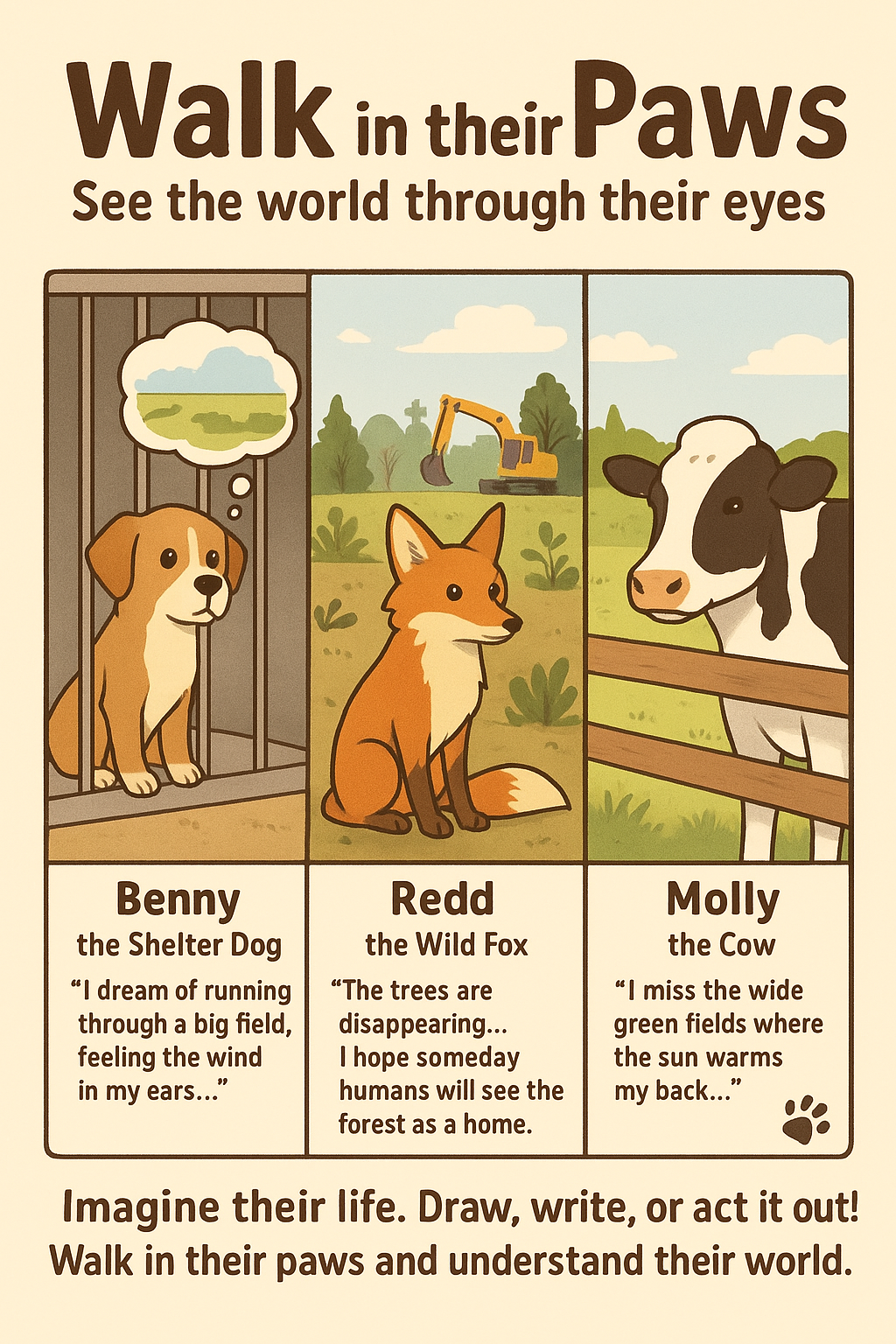
"Walk in Their Paws" – Diary of a Shelter Dog
Dear Diary,
Today was another quiet day at the shelter. The humans come and go, sometimes smiling, sometimes rushing past without noticing me. I wag my tail when someone looks my way, hoping they see more than just my fur. I dream of running through a big field, feeling the wind in my ears, not this cold, echoing walls.
Sometimes I hear the birds outside and imagine what it feels like to soar or to chase without limits. I wish someone would understand that I’m more than a dog waiting for adoption- I have feelings, dreams, and a heart that wants to love.
But tonight, I curl up on my blanket, hoping tomorrow someone will walk into my life and see the friend I’ve always wanted to be.
Paws and hugs,
Benny the Shelter Dog
"Walk in Their Paws" – Diary of a Young Fox
Dear Diary,
The trees are disappearing. Each day, I hear the hum of machines where the forest used to be. My den feels smaller, the paths I knew are gone, and the smells I relied on are fading. The river has less water, and the birds I used to chase have flown far away.
I hide in what’s left of the underbrush, trying to remember where it’s safe. I sniff the wind, hoping to find a patch of quiet, a place to play, a place to belong. But everything is changing too fast.
I hope someday, humans will see the forest not just as land to take, but as a home for all of us who live here.
Silent paws, Redd the Fox
"Walk in Their Paws" – Diary of a Dairy Cow
Dear Diary,
The mornings are loud. The humans come with their machines, and I stand in line, feeling the cold metal on my skin. I miss the wide green fields where the sun warms my back and the grass tastes sweet under my tongue.
Sometimes I dream of running with my friends, rolling in the soft earth, and listening to the birds instead of the clatter of the barn. But here, I eat, I wait, and I watch the world through the bars of my pen.
I hope one day, someone will let me feel the grass again, to know that life can be more than chores and waiting.
Gentle moo,
Molly the Cow
Why Do We Need Standards for Animal Protection? – Student Worksheet
Name: ___________________________ Date: _______________
Part 1 – Animal Welfare & Environmental Protection
How is animal welfare connected to environmental protection?
Give two examples of how protecting animals helps the environment:
Part 2 – Laws & Standards
What is the purpose of having international and national laws for animal protection?
Match the examples to the type of law or policy:
Example | Type
Protects endangered species from trade | ☐ International law ☐ National law ☐ Local policy
Requires pet owners to register and vaccinate animals | ☐ International law ☐ National law ☐ Local policy
Sets rules for humane treatment in animal shelters | ☐ International law ☐ National law ☐ Local policy
Standards in Animal Protection & Their Importance –
Student Worksheet
Name: ___________________________ Date: _______________
Part 1 – Understanding Standards
What are animal protection standards?
Give one example of each type:
Law: _______________________________________________
Ethical guideline: __________________________________
Shelter regulation: _________________________________
Wildlife protection policy: _________________________
Part 2 – Why Standards Matter
How do standards help prevent cruelty to animals?
List two ways standards help ensure animals’ needs are met:
Part 3 – The Bigger Picture
How does protecting animals also protect the environment?
How does animal welfare connect to human health?
Part 4 – Research Task
Choose two countries and compare their animal protection laws:
Country | Main Laws/Standards | Effectiveness
Grant Agreement No.: 2024-2-FR01-KA210-SCH-000290336
Icebreaker Game: Guess the Species
Instructions:Read the clues carefully and try to guess the species described. Write your answer on the line provided. After everyone has answered, we will discuss the correct answers together.
1. I am the largest land animal on Earth. I have big ears and a long trunk. What am I?Answer: _______________________________
2. I am a bird that cannot fly, but I am an excellent swimmer. I live mostly in cold places. What am I?
Answer: _______________________________
3. I have black and white stripes all over my body. I live in Africa and love to run fast. What am I?
Answer: _______________________________
4. I am a marine animal with eight arms. I am very intelligent and can squeeze through small spaces. What am I?
Answer: _______________________________
5. I am known as “man’s best friend.” I can be many breeds, sizes, and colors. What am I?Answer: _______________________________
6. I am a tall animal with a very long neck. I eat leaves from tall trees. What am I?Answer: _______________________________
7. I am a nocturnal animal with a keen sense of hearing. I can rotate my head almost all the way around. What am I?
Answer: _______________________________
Bonus: I am the king of the jungle, with a majestic mane. What am I?
Answer: _______________________________
Extra Activity:
Draw your favorite animal from the list above and write one fun fact about it:
Picture Suggestions for Each Species:
Elephant – a big elephant with visible trunk and ears
Penguin – a classic black and white penguin standing on ice
Zebra – close-up of black and white striped zebra
Octopus – an octopus with its eight arms spread out
Dog – a friendly dog, like a Labrador or any common breed
Giraffe – a tall giraffe reaching for leaves on a tree
Owl – a typical owl with big eyes perched on a branch
Lion (Bonus) – a lion with a majestic mane roaring or resting
Interactive Activity: Guess the Animal Game
Objective:To encourage students to practice descriptive language, listening skills, and learn about different animals.
How to Play:
Preparation:
Prepare a list of animals suitable for the students' age and language level.
Optionally, provide a set of animal flashcards (with pictures or names) for inspiration.
Instructions:
One student picks (or is assigned) an animal secretly.
Without naming the animal, the student gives clues using descriptive language. For example:
"It has stripes."
"It lives in the jungle."
"It eats meat."
The rest of the class guesses the animal based on the clues.
Rules:
No saying the name of the animal or using gestures (unless allowed).
Limit each student to 3–5 clues.
The first person to guess correctly earns a point or takes the next turn.
Optional Variations:
Team Play: Divide the class into teams. One person describes, the team guesses.
Time Challenge: Set a timer (e.g., 30 seconds) to guess each animal.
Charades Version: Students act like the animal instead of describing it.
Draw & Guess: Students draw the animal while others guess.
ANIMAL LOVERS (ALE+)
Erasmus+ school partnership promoting empathy, responsibility, and animal welfare education.